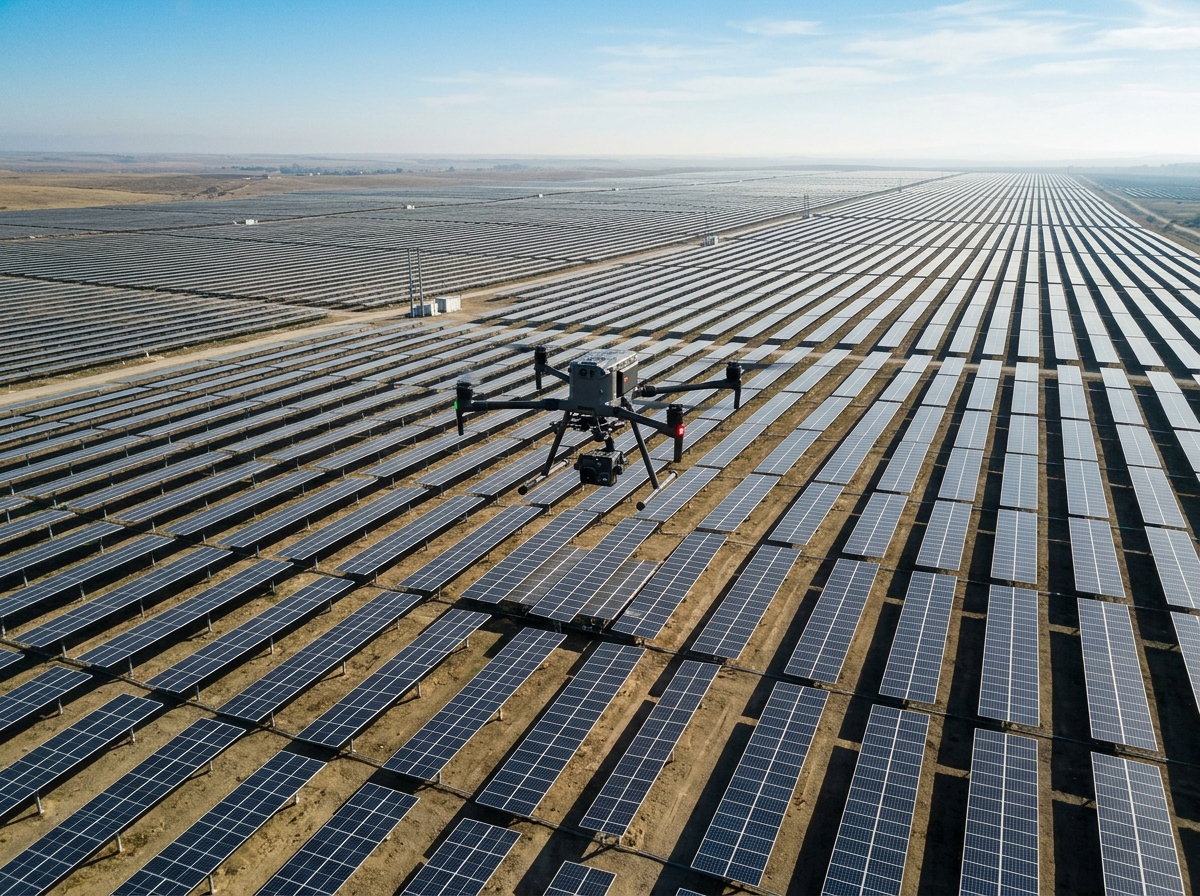
Aerial drone inspecting solar panel farm
Solar PV Thermography & Electroluminescence (EL)

Drone Thermography & Electroluminescence (EL) Inspection

The gold standard in utility-scale PV diagnostics. Combine daytime radiometric thermal audits with breakthrough aerial Electroluminescence (EL) testing to detect sub-surface silicon micro-cracks, cell fractures, and inactive wafer fragments — 50× faster than manual testing.

0.8 mmEL Crack Resolution
50+ MWDaily Inspection Capacity
IEC 60904-13EL Testing Compliant
100%Micro-Crack Detection Rate
Aerial Electroluminescence (EL) Testing✦Sub-Surface Micro-Crack Detection✦Radiometric Thermal Inspection✦IEC 60904-13 & IEC 62446-3✦Dead Cell Fragment Identification✦Pre-Commissioning COD Audits✦PID Degradation Mapping✦Aerial Electroluminescence (EL) Testing✦Sub-Surface Micro-Crack Detection✦Radiometric Thermal Inspection✦IEC 60904-13 & IEC 62446-3✦Dead Cell Fragment Identification✦Pre-Commissioning COD Audits✦PID Degradation Mapping✦
Next-Gen Drone Electroluminescence

Detecting Faulty Cells with Drone Electroluminescence (EL)

While thermal cameras detect hot spots after significant electrical degradation or cell burnout has already occurred, Electroluminescence (EL) imaging acts as an X-ray for solar panels. It exposes invisible structural flaws deep inside the silicon wafer long before thermal symptoms appear.

DronexAviation pioneers outdoor aerial EL testing using specialized drones equipped with cooled high-quantum-efficiency SWIR (Short-Wave Infrared 1150 nm) sensors. By forward-biasing the PV strings during dusk or night with controlled current injection, silicon cells emit near-infrared photons through radiative recombination.

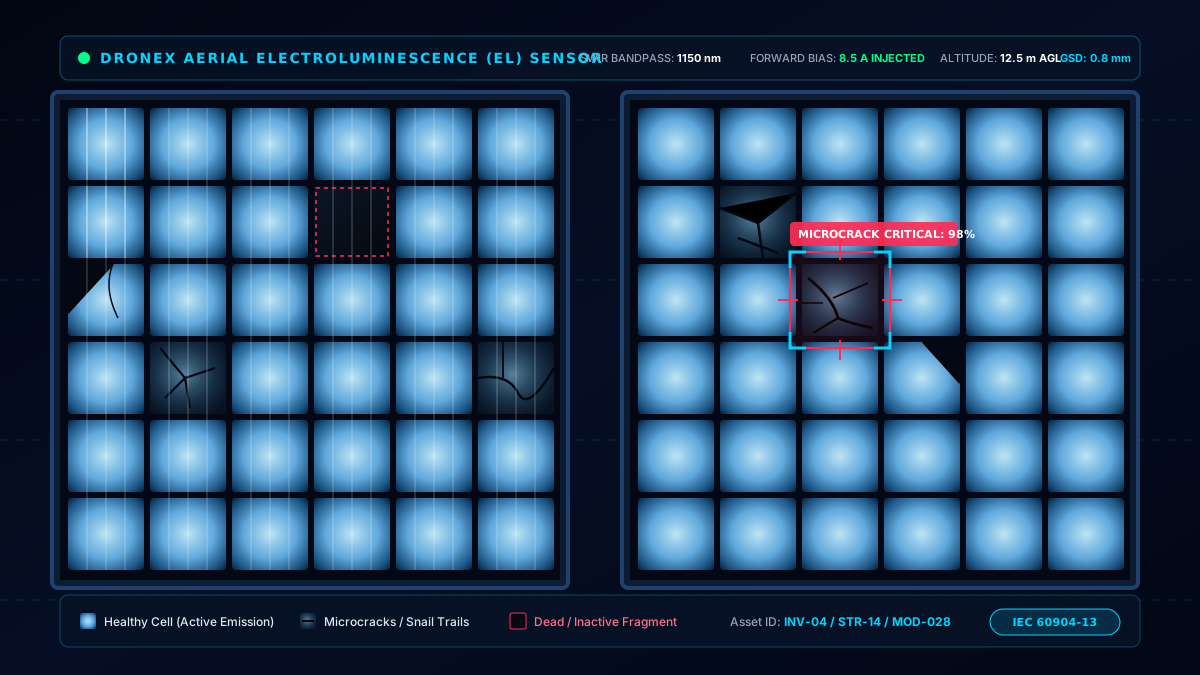
Healthy silicon glows uniformly bright under our drone sensors, whereas hairline microcracks, disconnected cell fragments, broken busbar fingers, PID shunting, and manufacturing soldering voids appear as distinct dark or black fissures with sub-millimeter clarity.

🔬 Sub-Surface Micro-Cracks

Detect hairline silicon wafer cracks caused by module transit vibration, rough handling, walking during installation, or hail impact.

⚡ Inactive Cell Fragments

Locate disconnected cell regions ("dead islands") that do not contribute to power production and cause severe string mismatch.

Electroluminescence EL solar panel drone inspection with glowing cells and detected microcracks
LIVE DRONE EL TELEMETRY Wavelength: 1150 nm | GSD: 0.8 mm/px
Inspection Feature Standard Thermal Thermography (IR) Dronex Aerial Electroluminescence (EL)
Inspection Principle Measures surface thermal radiation (8–14 µm) from energized operating panels under sunlight. Measures photon emission (1.15 µm) during forward current bias in dark / dusk conditions.
Hairline Micro-Cracks ✕ Invisible (unless severe heat localized hotspot forms) ✓ 100% visible with sub-millimeter fracture line resolution
Disconnected / Dead Cell Islands ✕ Difficult to quantify electrical separation ✓ Dead parts appear completely pitch black (0 photon emission)
Broken Busbar & Contact Fingers ✕ Undetectable at finger level ✓ Clear dark cross-hatch lines showing contact interruptions
Early Stage PID Degradation ✕ Only detectable after major power loss occurs ✓ Pinpoints characteristic edge-shunting and pattern dimming
Speed & Field Throughput 50 MW / day across open arrays in daytime 20–30 MW / night with drone automated string backfeeding
Applicable Standard IEC 62446-3 (Outdoor Infrared Thermography) IEC 60904-13 (Electroluminescence of PV Modules)

Safeguarding Solar Asset Performance with Complete Dual Diagnostics

In large-scale solar installations spanning hundreds of megawatts, reliance on daytime thermal cameras alone leaves critical blind spots. Thermal imaging identifies active hot spots and bypassed diodes, but cannot see non-heating microcracks that will propagate under seasonal thermal cycling and cause catastrophic cell failure down the line.

DronexAviation provides a comprehensive dual-inspection approach: daytime radiometric FLIR thermal mapping at 50 MW/day for instant defect tagging, combined with targeted nighttime/dusk Aerial Electroluminescence (EL) flights for high-risk strings, warranty claim validation, and commissioning acceptance.

Every defect is geo-indexed down to exact table, string, inverter block, and individual cell coordinates, providing asset managers and EPC contractors with legally defensible audit reports for tier-1 module manufacturer warranty claims.

Thermal and EL drone scanning utility-scale solar photovoltaic arrays
⚡
Dual Thermal & EL PayloadFLIR LWIR + SWIR 1150nm InGaAs

Complete Drone Solutions for Solar Power Plants

From pre-COD commissioning audits to post-storm insurance investigations and routine O&M.

Electroluminescence EL solar panel drone inspection
🔬

Electroluminescence (EL) Cell Diagnostics

Inject current into PV strings and capture near-infrared cell luminescence. Reveal invisible silicon micro-cracks, broken busbars, inactive cell corners, and soldering voids with sub-millimeter resolution.

Thermal hotspot detection on solar panels
🔥

Thermal Hotspot & Diode Detection

Detect localized overheating, bypassed sub-strings, PID hotspots, and high-resistance junction box solder joints. Thermal delta-T quantification categorizes severity per IEC 62446-3.

Bypass diode and string outage tracking
⚡

String Outages & Blown Fuses

Identify completely offline strings, blown combiner box fuses, and inverter trips across thousands of rows. Inactive strings show uniform cold signatures compared to energized modules.

Pre-commissioning COD solar handover audit
✅

Pre-COD Commissioning & Handover

Perform 100% baseline health audits prior to commercial operation (COD). Prove EPC transit damage or installer walking microcracks via EL imaging before signing completion handovers.

Hailstorm and extreme weather damage assessment
🌪

Hailstorm & Severe Weather Audits

Following hailstorms or high-wind cyclonic events, front glass may look unbroken while internal silicon wafers are shattered. Aerial EL proves internal microcrack damage for insurance settlement.

Topographic site planning and shading modeling
🗺

Pre-Construction Topography & Shading

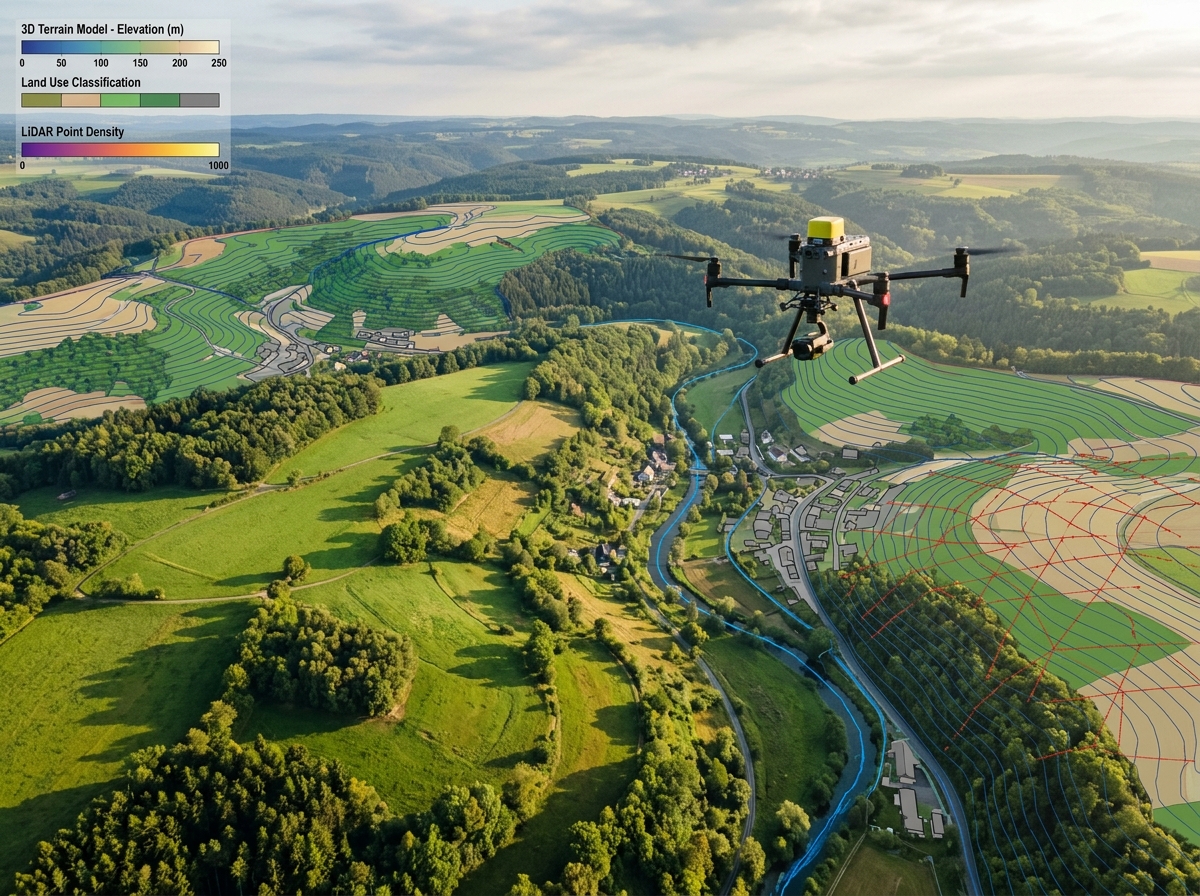
High-precision LiDAR and photogrammetry for proposed solar plant sites. Generate high-resolution digital elevation models (DEM) for civil grading, tracker slope planning, and shading simulations.

Our Standardized Solar Audit Workflow

Integrating daytime IEC 62446-3 thermography and nighttime IEC 60904-13 Electroluminescence testing.

01

Daytime Aerial Thermal Flight

RTK-guided UAV flies synchronized grids during peak irradiance (>600 W/m²), capturing radiometric LWIR thermal and 4K RGB imagery across the entire solar field.

02

String Biasing & Night Aerial EL

During dusk or night, strings are forward-biased using specialized mobile DC power sources. Drone equipped with SWIR 1150nm sensor flies low over arrays capturing luminescent cell radiation.

03

AI Anomaly & Crack Triage

Computer vision algorithms detect hotspots, classify microcrack networks, measure crack lengths, and evaluate cell power degradation percentages against CAD single-line diagrams.

04

Certified Audit Dossier

Clients receive an interactive digital twin portal, CSV punch lists with GPS coordinates for technicians, and signed IEC 62446-3 & IEC 60904-13 compliance certificates for warranty claims.

Why Solar Asset Managers Choose DronexAviation

🔬

Unmatched Cell Diagnosis

Catch microcracks and wafer fractures that are completely invisible to standard thermal cameras before they turn into costly burnouts.

0.8 mm Crack Precision
🚀

50x Faster Inspection

A 100 MW solar plant that takes manual ground crews months to inspect is completely surveyed in days by our high-endurance UAVs.

2 Days vs. 60 Days
💲

Revenue Recovery

Eliminating diode shorts, cell cracks, and blown fuses directly recovers 3% to 5% of lost annual plant generation capacity.

+3-5% Annual Yield
📝

Accelerated Warranty Claims

Tier-1 module manufacturers demand EL proof to honor factory warranty claims on cracked cells. Our reports are 100% manufacturer accepted.

100% OEM Acceptance
🛡

Fire Risk Prevention

Severe cell micro-cracks concentrate current into hot spots reaching 140°C. Early detection prevents junction box fires and inverter damage.

Zero Plant Fires
💻

25-Year Digital Twin

Compare thermal and EL signatures across multi-year flight epochs to monitor degradation velocity over the plant's 25-year operational lifecycle.

Lifecycle Traceability

Solar Audit Deliverables Package

Everything your O&M engineers, asset owners, and financiers need to quantify losses and execute maintenance.

🔬

Electroluminescence (EL) Cell Mosaic

High-resolution near-infrared orthomosaic revealing internal silicon wafer microcracks, dead cell fragments, and busbar contacts.

🌡

Radiometric Thermal Orthomosaic

Complete radiometric GeoTIFF map where every pixel contains calibrated surface temperature data.

📋

IEC 62446-3 & IEC 60904-13 Audit Report

Formal comprehensive audit report with categorized defect counts (critical, major, minor), temperature deltas, and estimated power loss calculations.

📍

Field Punch List (CSV / GeoJSON)

Exportable maintenance table with GPS coordinates, table number, string ID, and recommended corrective action for ground technicians.

🌐

Cloud Digital Twin Portal

Secure web-based viewer to filter anomalies by severity, compare year-over-year thermal signatures, and track repair sign-offs.

Solar farm aerial EL and thermal inspection deliverables

Frequently Asked Questions

Thermal imaging (IR) detects heat differences on operating panels during sunlight, revealing active hot spots and diode failures. Electroluminescence (EL) acts like an X-ray: when forward electrical current is injected into PV strings in low-light conditions, healthy silicon emits near-infrared photons. Broken silicon wafers, invisible microcracks, dead cell fragments, and broken busbar fingers show up as dark lines and patches. EL detects defects before they ever heat up or cause fires.

Historically, EL testing required dismantling modules and testing them inside dark laboratory chambers or using cumbersome manual carts at night (testing only ~100 panels/night). DronexAviation utilizes drone-based outdoor EL: we forward-bias entire PV strings from the inverter or DC combiner box using mobile power supplies, and our low-flying UAV equipped with cooled SWIR (1150nm) sensors scans thousands of panels per hour at night or dusk with sub-millimeter resolution.

During plant construction, installers frequently step or kneel on panels, causing internal wafer fractures that are completely invisible from the outside. Similarly, hailstorms often shatter the internal silicon wafer without breaking the tempered front glass. Drone EL is the only non-destructive test that indisputably proves internal wafer damage for EPC handover punch lists and insurance claims.

For thermal inspections (IEC 62446-3), daytime plane-of-array irradiance must exceed 600 W/m² with clear skies and wind speeds under 4 m/s. For Electroluminescence (EL) inspections (IEC 60904-13), flights are conducted at night, dusk, or overcast low-ambient light conditions so ambient sunlight does not drown out the delicate 1150 nm photon luminescence.

Yes. Our thermographers and EL diagnostic engineers follow IEC 62446-3 and IEC 60904-13 protocols. Major tier-1 module manufacturers accept our calibrated EL imagery and radiometric thermography packages for processing module replacement warranty claims.

Explore Our Other Industry Solutions

Ready to Uncover Invisible Solar Cell Defects?

Contact our aerial solar inspection specialists today to book a dual Electroluminescence (EL) and thermal audit for your solar power facility.